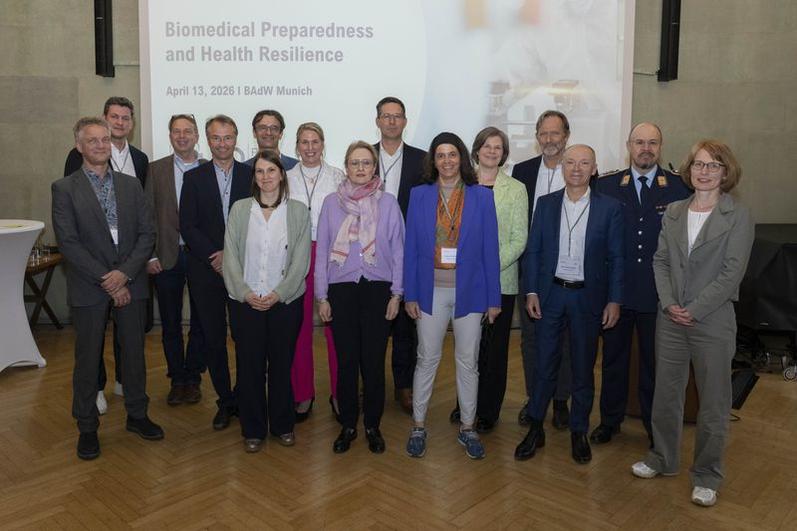
Over 100 participants from academia, industry, healthcare, and politics, including Professor Michael Hoelscher (Institute of Infectious Diseases and Tropical Medicine, LMU University Hospital/Fraunhofer ITMP-IIP), came together to discuss perspectives and innovative approaches to preparing for potential pandemic and crisis situations in healthcare. It became clear that effective preparation for infectious disease outbreaks can only be achieved through the interplay of prevention, surveillance, and rapid response capabilities. In this context, Bavaria plays a central role in the further development of innovative healthcare solutions thanks to its strong research landscape and targeted initiatives.
The event brought together leading national experts, including representatives from Roche, the Robert Koch Institute, the Bundeswehr, Fraunhofer, Helmholtz Munich, both Munich universities, and other key organizations in the fields of infectious disease research and healthcare innovation.
It showed that effective pandemic prevention can only succeed through an integrated combination of prevention, surveillance, and rapid response capabilities. Bavaria is contributing to this effort both through its strength as a leading research hub and through targeted initiatives.
Key messages for the future design of healthcare and resilience can be derived from the discussions:
- Pandemics do not respect borders: international health protection is national health protection – nobody is safe until everyone is safe.
- We must adopt dual-use strategies to ensure that prevention, diagnostics, therapeutics, and surveillance are crisis-ready – pandemic preparedness is not optional, especially in times of geopolitical challenges.
- Research, development, and production need to be independent from third countries and global supply chains.
- Clear responsibilities and governance are crucial, alongside more speed, more money, and less bureaucracy.
- Environmental factors matter for public health resilience. If ignored, it affects public health and increases healthcare costs.
- Building trust requires training of communicators, medical staff, and the broader population.
- We have to build bridges by aligning language, data, structures, and activities across borders.
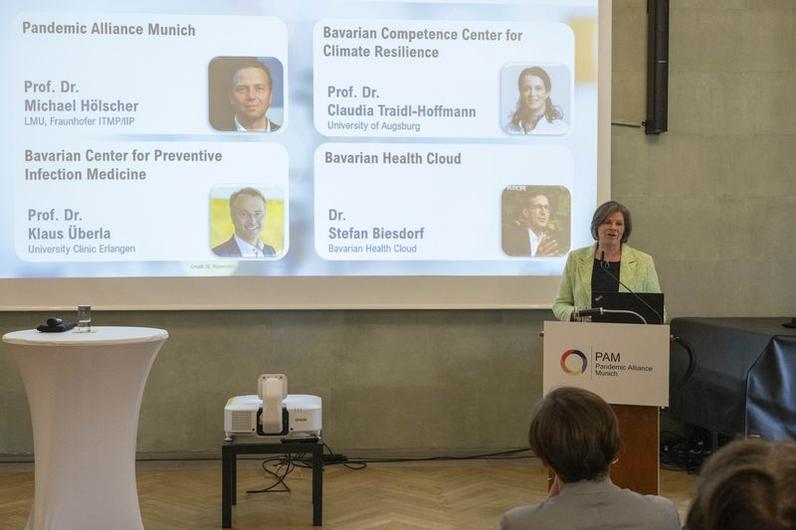
The focus was on current European and national strategies for pandemic prevention, as well as the role of regional initiatives. The event highlighted key Bavarian projects such as the Pandemic Alliance Munich (PAM), the Bayerische Zentrum für präventive Infektionsmedizin (BZI), the Bayerische Kompetenzzentrum für Gesundheitsschutz im Klimawandel und die Bavarian Health Cloud (BHC). These initiatives exemplify how Bavaria is pooling its strengths in research, translational medicine, and digitalization in the health sector.
Another key focus was on how cross-sectoral collaboration can be strengthened. In interactive discussion formats, participants exchanged views on the necessary framework conditions for innovation in healthcare – ranging from data infrastructure and regulatory aspects to financing and international cooperation.
Read more about the event (Website BioM)