AG Gärtner
Cell and mechanobiology of migrating cells - effects on cardiovascular biology
General questions
How do cells control their shape and movement?
How can we use this knowledge to develop new therapeutic strategies for the treatment of cardiovascular and inflammatory diseases?
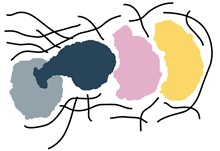
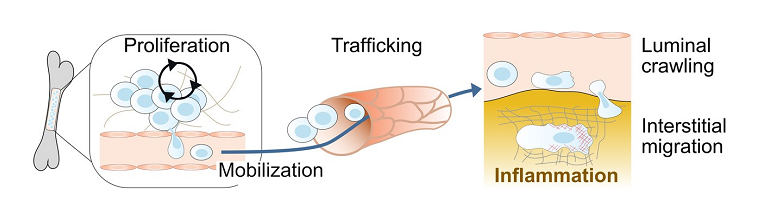
All immune cells, including platelets and leukocytes, are formed in the bone marrow before they enter the bloodstream to circulate through the body and monitor the organism for signs of danger. On their journey, they are subjected to various mechanical challenges, including shear forces exerted by the bloodstream and tensile and compressive forces from the tissue microenvironment, which they actively monitor. This makes their seemingly effortless movement through the body all the more astonishing and raises the fundamental question of how cells control their shape and movement in tissue environments.
Methods
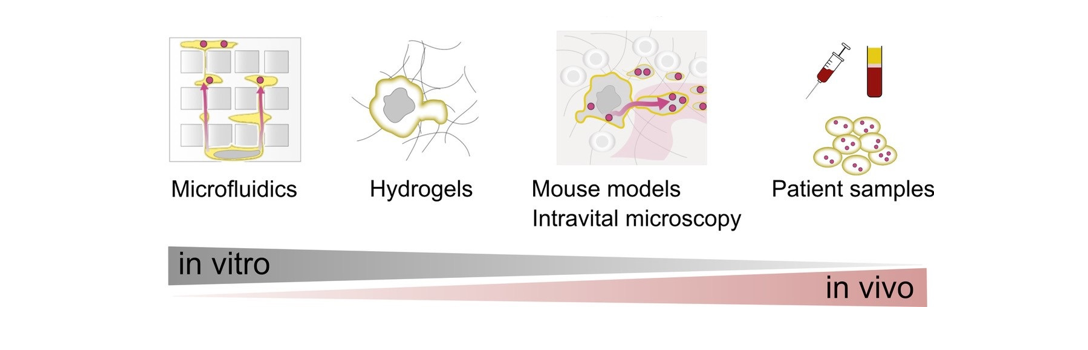
Our laboratory addresses these questions with a multidisciplinary approach that combines mouse genetics, microfluidics, quantitative microscopy and intravital imaging techniques to study cell motility in physiological tissue environments.
Cell and mechanobiology of platelet migration
Despite not having a nucleus, platelets are at the forefront of the mammalian immune response, constantly patrolling the vasculature to detect signs of injury and inflammation. When a vessel leaks, platelets are immediately activated and seal the lesion by forming a plug - a process required to maintain vascular integrity during inflammation. We have shown that platelets have the migratory capacity required to direct them to sites of vascular injury and are essential for the precise closure of micro-injuries in inflamed blood vessels. However, the role of platelet migration goes beyond hemostasis. Migrating platelets scan their environment for pathogenic invaders and accumulate bacteria to prevent their spread in the organism.
Our goal is to gain a better mechanistic understanding of this novel platelet function, which offers a unique opportunity to develop new and more specific therapeutic strategies for the treatment or prevention of thrombotic and infectious diseases.
Cell mechanics of megakaryocytes in 3D tissues
A homeostatic platelet count is critical for vascular integrity and vital. Megakaryocytes are giant hematopoietic cells that form large protrusions that fragment to constantly replenish the circulating platelet pool. Yet severe blood loss, infections and aggressive cancer therapies often result in critically low platelet levels - a major public health problem for ageing populations. Despite the unmet clinical need to control platelet production, there is a major lack of knowledge about the mechanistic cell biology of megakaryocytes, which hampers the development of innovative therapies. To address this issue, we are integrating cell biological and biophysical tools to study megakaryocytes in physiological tissue environments and uncover the mechanistic principles that govern platelet formation.
Selected publications:
- R. Kaiser, A. Anjum, L. Kammerer, Q. Loew, A. Akhalkatsi, D. Rossaro, R. Escaig, A. Droste zu Senden, C. Gold, K. Pekayvaz, M. Lorenz, T. Brocker, J. Kranich, J. Walter Holch, K. Spiekermann, S. Massberg, F. Gaertner#, L. Nicolai# (2023). "Mechanosensing via a GpIIb/Src/14-3-3ζ axis critically regulates platelet migration in vascular inflammation." Blood, 2023 Jun 15;141(24):2973-2992. doi: 10.1182/blood.2022019210. (# shared senior author)
- F. Gaertner, P. Reis-Rodrigues, I. de Vries, M. Hons, J. Aguilera, M. Riedl, A. Leithner, S. Tasciyan, A. Kopf, J. Merrin, V. Zheden, W. A. Kaufmann, R. Hauschild, M. Sixt (2022). "WASp triggers mechanosensitive actin patches to facilitate immune cell migration in dense tissue". Developmental Cell 57, 47-62
- Reversat, A., F. Gaertner, J. Merrin, J. Stopp, S. Tasciyan, J. Aguilera, I. de Vries, R. Hauschild, M. Hons, M. Piel, A. Callan-Jones, R. Voituriez and M. Sixt (2020). "Cellular locomotion using environmental topography." Nature. 582, 582-585.
- Nicolai, L., K. Schiefelbein, S. Lipsky, A. Leunig, M. Hoffknecht, K. Pekayvaz, B. Raude, C. Marx, A. Ehrlich, J. Pircher, Z. Zhang, I. Saleh, A. K. Marel, A. Lof, T. Petzold, M. Lorenz, K. Stark, R. Pick, G. Rosenberger, L. Weckbach, B. Uhl, S. Xia, C. A. Reichel, B. Walzog, C. Schulz, V. Zheden, M. Bender, R. Li, S. Massberg and F. Gaertner (2020). "Vascular surveillance by haptotactic blood platelets in inflammation and infection." Nat Commun 11(1): 5778. featured in a Nature Communications Editors' Highlights webpage
- Gaertner, F., Z. Ahmad, G. Rosenberger, S. Fan, L. Nicolai, B. Busch, G. Yavuz, M. Luckner, H. Ishikawa-Ankerhold, R. Hennel, A. Benechet, M. Lorenz, S. Chandraratne, I. Schubert, S. Helmer, B. Striednig, K. Stark, M. Janko, R. T. Böttcher, A. Verschoor, C. Leon, C. Gachet, T. Gudermann, M. Mederos y Schnitzler, Z. Pincus, M. Iannacone, R. Haas, G. Wanner, K. Lauber, M. Sixt and S. Massberg (2017). "Migrating Platelets Are Mechano-scavengers that Collect and Bundle Bacteria." Cell 171(6): 1368-1382.e1323. Highlighted in Immunity, Nat Rev Immunol, Cell, Der Spiegel
- Gaertner, F., Ishikawa-Ankerhold, H., Stutte, S., Fu W. et al. Plasmacytoid dendritic cells control homeostasis of megakaryopoiesis. Nature 631, 645-653 (2024). https://doi.org/10.1038/s41586-024-07671-y
Reviews an editorials:
F. Gaertner, M. Sixt (2021). "Cells employ front-wheel drives to pull themselves through fibrous terrain". Dev Cell.
- Nicolai, L., F. Gaertner* and S. Massberg* (2019). "Platelets in Host Defense: Experimental and Clinical Insights." Trends Immunol 40(10): 922-938 (*co-last author)
- Gaertner, F. and S. Massberg (2019). "Patrolling the vascular borders: platelets in immunity to infection and cancer." Nat Rev Immunol 19(12): 747-760.
- Gaertner, F. and S. Massberg (2016). Blood coagulation in immunothrombosis-At the frontline of intravascular immunity. Seminars in Immunology, 28(6):561-569.
Project: MEKanics - Cell mechanics of megakaryocytes in 3D tissues- deciphering mechanobiology of platelet formation
Heisenberg Program "Deciphering the mechanics that control cell shape and movement in living tissues - implications for cardiovascular biology"

Project: The role of Piezo 1 in mechanosensing and mechanotransduction of migrating platelets

Partner site project
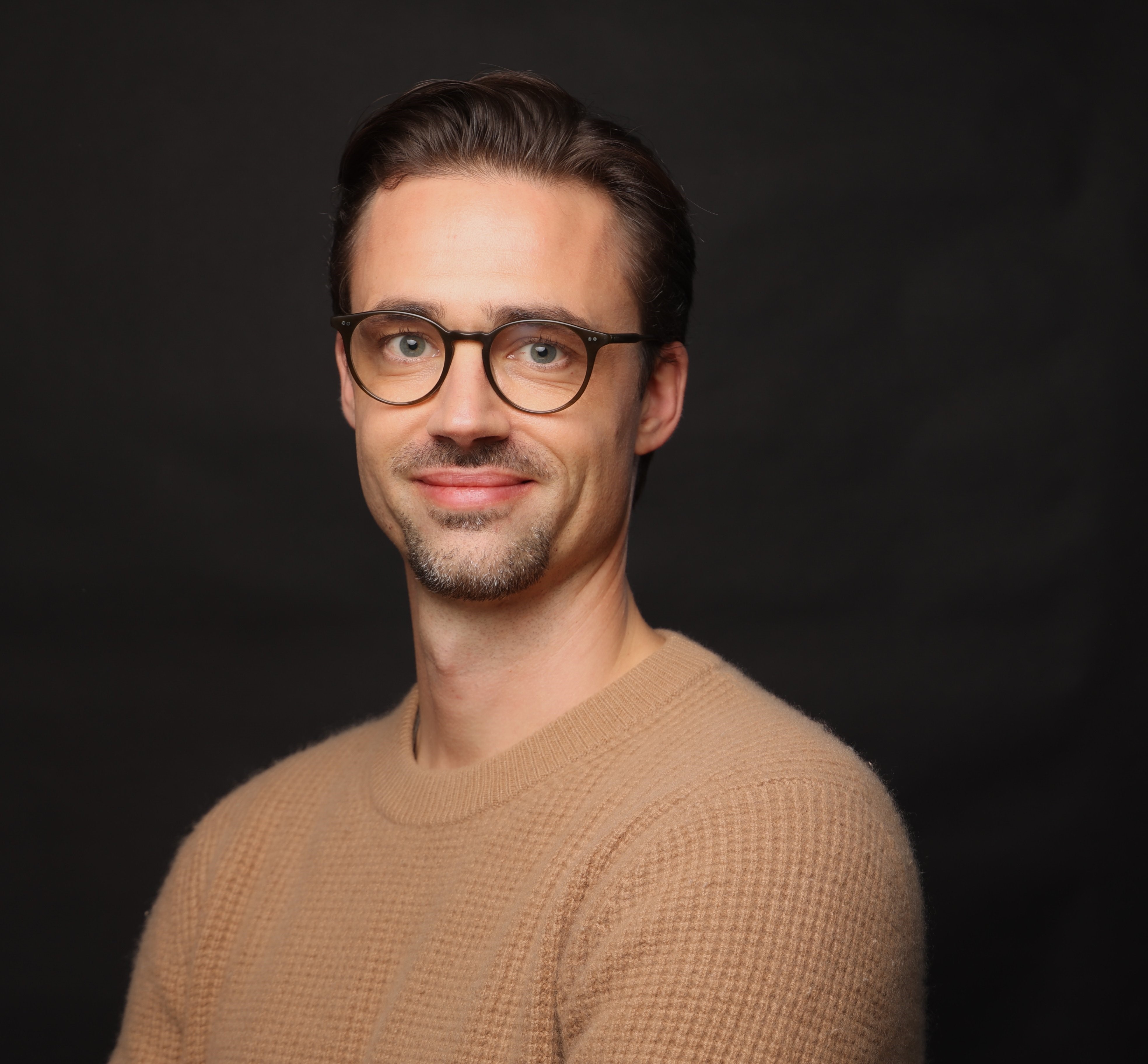
Prof. Dr. med. Florian Gärtner, PhD
PI
Dr. med. Suhxia Fan, PhD
PostDoc
Dr. med. Wenwen Fu, PhD
PostDoc
Madeleine Schmitt
PostDoc
Anita Stoppel
PhD
Andreas Friedrich
MD student
Roshini Rajaraman
PhD student
Jay Chen
PhD
Yongfa Dai
PhD