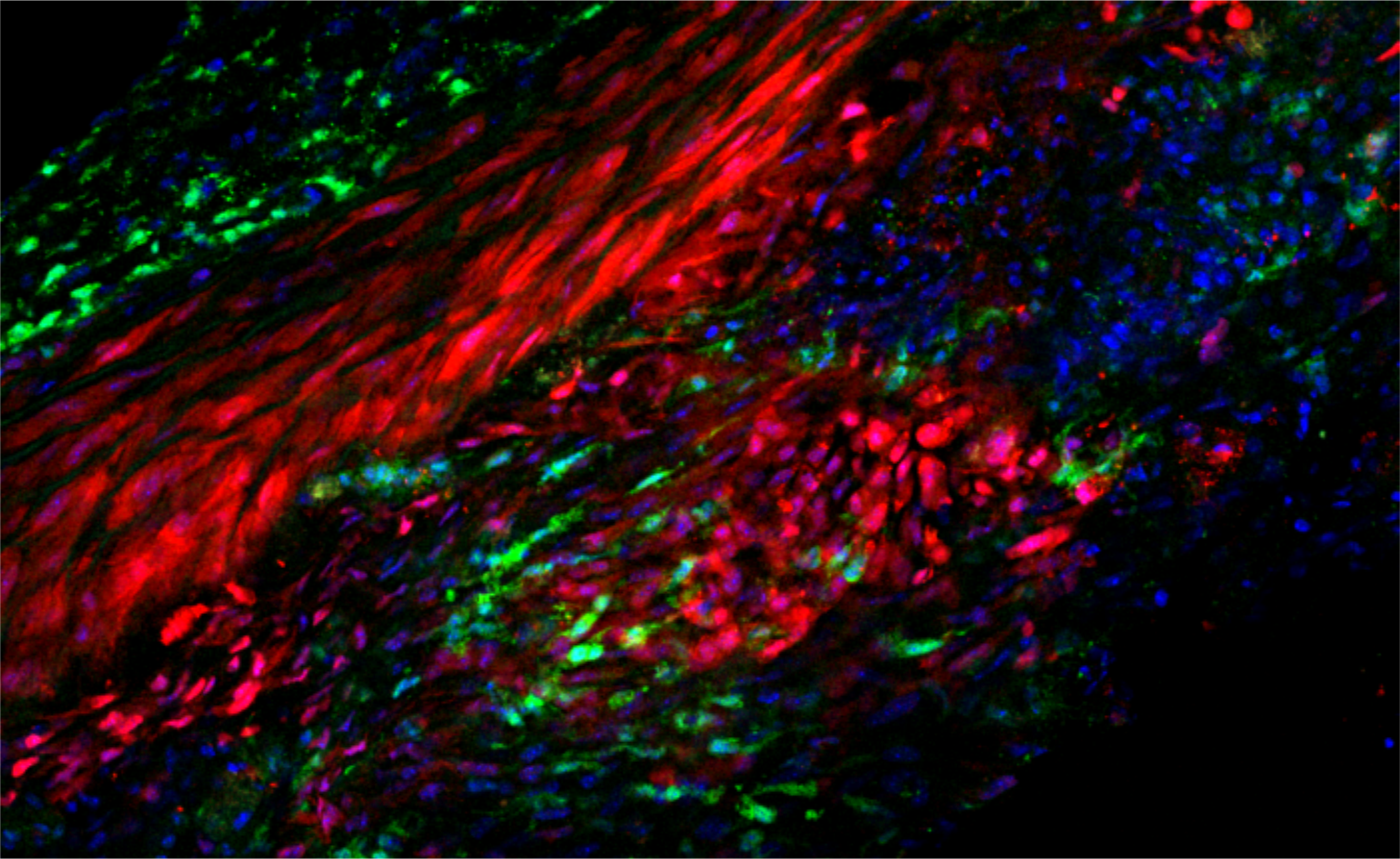
Pekayvaz K, Gold C, Hoseinpour P, Engel A, Martinez-Navarro A, Eivers L, Coletti R, Joppich M, Dionísio F, Kaiser R, Tomas L, Janjic A, Knott M, Mehari F, Polewka V, Kirschner M, Boda A, Nicolai L, Schulz H, Titova A, Kilani B, Lorenz M, Fingerle-Rowson G, Bucala R, Enard W, Zimmer R, Weber C, Libby P, Schulz C, Massberg S, Stark K (2023) Mural cell-derived chemokines provide a protective niche to safeguard vascular macrophages and limit chronic inflammation. Immunity. 2023 Oct 10;56(10):2325-2341.e15.
Kaiser R, Gold C, Joppich M, Loew Q, Akhalkatsi A, Mueller TT, Offensperger F, Droste Zu Senden A, Popp O, di Fina L, Knottenberg V, Martinez-Navarro A, Eivers L, Anjum A, Escaig R, Bruns N, Briem E, Dewender R, Muraly A, Akgöl S, Ferraro B, Hoeflinger JKL, Polewka V, Khaled NB, Allgeier J, Tiedt S, Dichgans M, Engelmann B, Enard W, Mertins P, Hubner N, Weckbach L, Zimmer R, Massberg S, Stark K*, Nicolai L*, Pekayvaz K* (2024) Peripheral priming induces plastic transcriptomic and proteomic responses in circulating neutrophils required for pathogen containment (2024). Sci Adv. 2024 Mar 22;10(12):eadl1710. *contributed equally
Pekayvaz K, Leunig A, Kaiser R, Joppich M, Brambs S, Janjic A, Popp O, Nixdorf D, Fumagalli V, Schmidt N, Polewka V, Anjum A, Knottenberg V, Eivers L, Wange LE, Gold C, Kirchner M, Muenchhoff M, Hellmuth JC, Scherer C, Rubio-Acero R, Eser T, Deák F, Puchinger K, Kuhl N, Linder A, Saar K, Tomas L, Schulz C, Wieser A, Enard W, Kroidl I, Geldmacher C, von Bergwelt-Baildon M, Keppler OT, Munschauer M, Iannacone M, Zimmer R, Mertins P, Hubner N, Hoelscher M, Massberg S, Stark K*, Nicolai L* (2022). Protective immune trajectories in early viral containment of non-pneumonic SARS-CoV-2 infection. Nat. commun. 2022 Feb 23;13(1):1018. *contributed equally
Pekayvaz K, Losert C, Knottenberg V, Gold C, V. van Blokland I, Oelen R, E. Groot E, Walter Benjamins J, Brambs S, Kaiser R, Gottschlich A, Hoffmann G, Eivers L, Martinez-Navarro A, Bruns N, Stiller S, Akgöl S, Yue K, Polewka V, Escaig R, Joppich M, Janjic A, Popp O, Kobold S, Stark K (2024) Multiomic analyses uncover immunological signatures in acute and chronic coronary syndromes. Nat Med (2024)