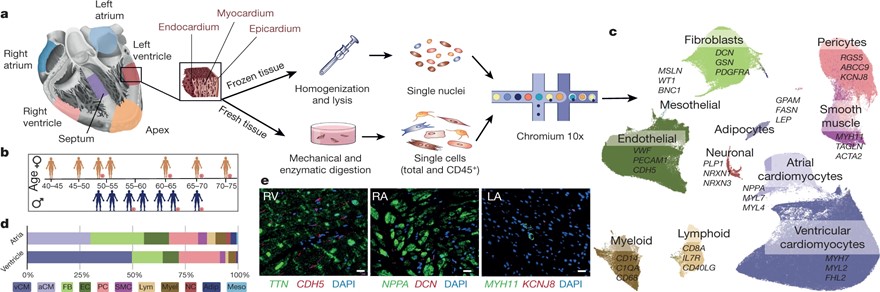
Cardiac tissue consists of several different cell types such as cardiomyocytes, fibroblasts or macrophages. This cellular diversity is required for normal cardiac contractility, relaxation and excitability. Single cell techniques extract cell type-specific information by measuring the transcriptome of each cardiac cell type, which helps to decipher the genetic information of healthy and diseased hearts. This technique enables the analysis of compositional changes and heterogeneity within each cell type and state (= cell subtypes). ScRNA-seq using droplet-based microfluidics combines high throughput, good sensitivity and broad applicability. However, due to their cell size of 100 x 25 μm, adult cardiac myocytes are not compatible with droplet-based microfluidic scRNA-seq techniques. Since the average diameter of their cell nuclei is 8-12 μm, single-nucleus RNA sequencing (snRNA-seq) of cardiac tissue offers a robust alternative to scRNA-seq and captures data from all cardiac lineages - even from frozen tissue.
LMU Klinikum
The 11 most important cell types and representative marker genes of the adult human heart are shown in a two-dimensional representation using the 'Uniform Manifold Approximation and Projection' (UMAP). Each dot represents a detected nucleus. Modified from Nature, 588, pp. 466-72 (2020).
Gene editing
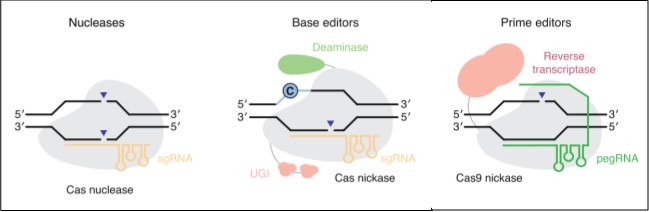
Nucleic acid therapies are potential therapeutic approaches for genetic cardiovascular diseases. DNA modification can be achieved with genome editors delivered by vectors such as adeno-associated viruses or liponanoparticles. CRISPR-based tools such as base or prime editing enable precise and efficient genome editing - even in post-mitotic cells - allowing monogenetic cardiovascular diseases to be modified.
LMU Klinikum
Three different types of CRISPR-based tools: nucleases, base editors and prime editors. Modified from Nature Biotechnology, 38, pages 824-44 (2020)
Selected publications
Pathogenic variants damage cell composition and single cell transcription in cardiomyopathies: Reichart D*, Lindberg EL*, Maatz H*, Miranda AMA, Viveiros A, Shvetsov N, Gärtner A, Nadelmann ER, Lee M, Kanemaru K, Ruiz-Orera J, Strohmenger V, DeLaughter DM, Patone G, Zhang H, Woehler A, Lippert C, Kim Y, Adami E, Gorham JM, Barnett SN, Brown K, Buchan RJ, Chowdhury RA, Constantinou C, Cranley J, Felkin LE, Fox H, Ghauri A, Gummert J, Kanda M, Li R, Mach L, McDonough B, Samari S, Shahriaran F, Yapp C, Stanasiuk C, Theotokis PI, Theis FJ, van den Bogaerdt A, Wakimoto H, Ware JS, Worth CL, Barton PJR, Lee YA, Teichmann SA, Milting H#, Noseda M#, Oudit GY#, Heinig M#, Seidman JG#, Hubner N#, Seidman CE#. Science. 2022 Aug 5;377(6606):eabo1984. doi: 10.1126/science.abo1984.
Efficient in vivo genome editing prevents hypertrophic cardiomyopathy in mice: Reichart D*, Newby GA*, Wakimoto H*, Lun M, Gorham JM, Curran JJ, Raguram A, DeLaughter DM, Conner DA, Marsiglia JDC, Kohli S, Chmatal L, Page DC, Zabaleta N, Vandenberghe L, Liu DR, Seidman JG, Seidman C., Nat Med. 2023 Feb;29(2):412-421. doi: 10.1038/s41591-022-02190-7.
Cells of the adult human heart: Litviňuková M*, Talavera-López C*, Maatz H*, Reichart D*, Worth CL, Lindberg EL, Kanda M, Polanski K, Heinig M, Lee M, Nadelmann ER, Roberts K, Tuck L, Fasouli ES, DeLaughter DM, McDonough B, Wakimoto H, Gorham JM, Samari S, Mahbubani KT, Saeb-Parsy K, Patone G, Boyle JJ, Zhang H, Zhang H, Viveiros A, Oudit GY, Bayraktar OA, Seidman JG, Seidman CE, Noseda M, Hubner N, Teichmann SA.. Nature. 2020 Dec;588(7838):466-472. doi: 10.1038/s41586-020-2797-4.
Project: The ageing heart: exploring new markers of ageing and investigating new treatment options
2024 - 2027
Project: Closing the gap - optimizing gene editing of hypertrophic cardiomyopathy for clinical application
2024 - 2027
Project : New insights into xenotransplantation through retrospective investigation of pioneering preclinical and clinical studies using innovative technologies
Nursing with heart and expertise: Experience the Nursing Careers Day at LMU Hospital on June 27, 2025 - a day full of inspiring insights into the demanding and holistic everyday life of nursing. Meet experts, discover a wide range of career opportunities and receive exciting information on jobs, training and further education. Come along, exchange ideas with colleagues and let yourself be inspired by nursing science in practice - without obligation and without registration.